
Showing posts with label linux. Show all posts
Showing posts with label linux. Show all posts
Monday, 27 April 2026
Lazy tooling: Magick Image Annotations
Preparing various images of different sizes for a standardised dsiplay can be hugely time consuming and manual. How can we be lazy about this?

Thursday, 1 January 2026
Precision Macro: Using the Nikon D300 with LiveView and Focus Peaking on Linux
Macro photography is a game of millimeters. When you are shooting at 1:1 magnification, the depth of field is so thin that even the slightest movement or a poorly calibrated viewfinder can ruin a shot.
The Nikon D300, while a solid workhorse even more than a decade and a half later, lacks the modern "Focus Peaking" found in mirrorless cameras. However, with a Linux machine, some open-source tools, and a custom Python script, we can give legacy liveview enabled DSLR real-time focus assistance.
Thursday, 15 February 2024
Halide Linux Digital Workflow with RawTherapee
Phone cameras have steadily been improving over the last decade but one issue for serious photographers has been the ability to obtain full control of their camera settings and then the ability to obtain a RAW image for imrproved processing.

The recent iPhone Pro Max models have Apple ProRAW and can be enabled by default for the iOS camera, but if you have the non-Pro Max models you will need specific camera apps to allow you to make the most of the camera sensor.
The Halide MkII app has been a very good camera app that gives us RAW images - coupled with the OpenSource RAW editor RawTherapee we have, in my opinion, the basis for acceptable iPhone digital workflow.
The recent iPhone Pro Max models have Apple ProRAW and can be enabled by default for the iOS camera, but if you have the non-Pro Max models you will need specific camera apps to allow you to make the most of the camera sensor.
The Halide MkII app has been a very good camera app that gives us RAW images - coupled with the OpenSource RAW editor RawTherapee we have, in my opinion, the basis for acceptable iPhone digital workflow.
Friday, 23 June 2023
Valgrind: noise reduction
Ensuring your delivered code is memory leak free is a standard concern for C/C++ developers and 
valgrind is a great tool to assist. One problem we can run into is extra noise from system/non project libraries masking your own issues. Refocussing is relatively straight forward:
Saturday, 14 January 2023
Faking RPM db dependancies
The fedora packager manager takes care of all your dependancies but how do we deal with user compiled binaries and misisng dependencies?

Tuesday, 5 July 2022
A local Openshift 4.x development environment on your laptop
Having access to dev

Setting up the rest of the cluster and dev ecosystem is a little complicated at first so here's a set of notes documenting how it can be done on an 8core / 16Gb Fedora 35 machine.
OpenShift 4.x cluster that you control is invaluable - Redhat now provides this ability through their Code Ready Container also known an crc
Setting up the rest of the cluster and dev ecosystem is a little complicated at first so here's a set of notes documenting how it can be done on an 8core / 16Gb Fedora 35 machine.
Sunday, 10 April 2022
Custom live Linux USB image: Working around locked down ThinkPad
At work we are getting pushed into a hot-desking setup and each member of staff is being moved onto a thin client ThinkPad. Of course a thin client is nothing more than a customised and stripped down Windows 10 build that connects to the firm's virtual desktop infrastructure, via a combination of CiscoConnect and VMWare Horizon client.
Since we're being forced to carry the ThinkPad to and from the hot-desk office, I'm going to use the ThinkPad for my own dev purposes en route. The ThinkPad's BIOS is not locked down so we can get into the boot menu via

Since we're being forced to carry the ThinkPad to and from the hot-desk office, I'm going to use the ThinkPad for my own dev purposes en route. The ThinkPad's BIOS is not locked down so we can get into the boot menu via
F12 or the BIOS setup via Enter but setting my own dev environment is not straight forward.
Sunday, 27 February 2022
Ardour DAW on Fedora
Whilst

audacity is a well known and simple sound editor it has some limitations when compared to digitial audio workstations (DAWs): this space can be fileld with ardour and a number of basic plugins.Wednesday, 15 December 2021
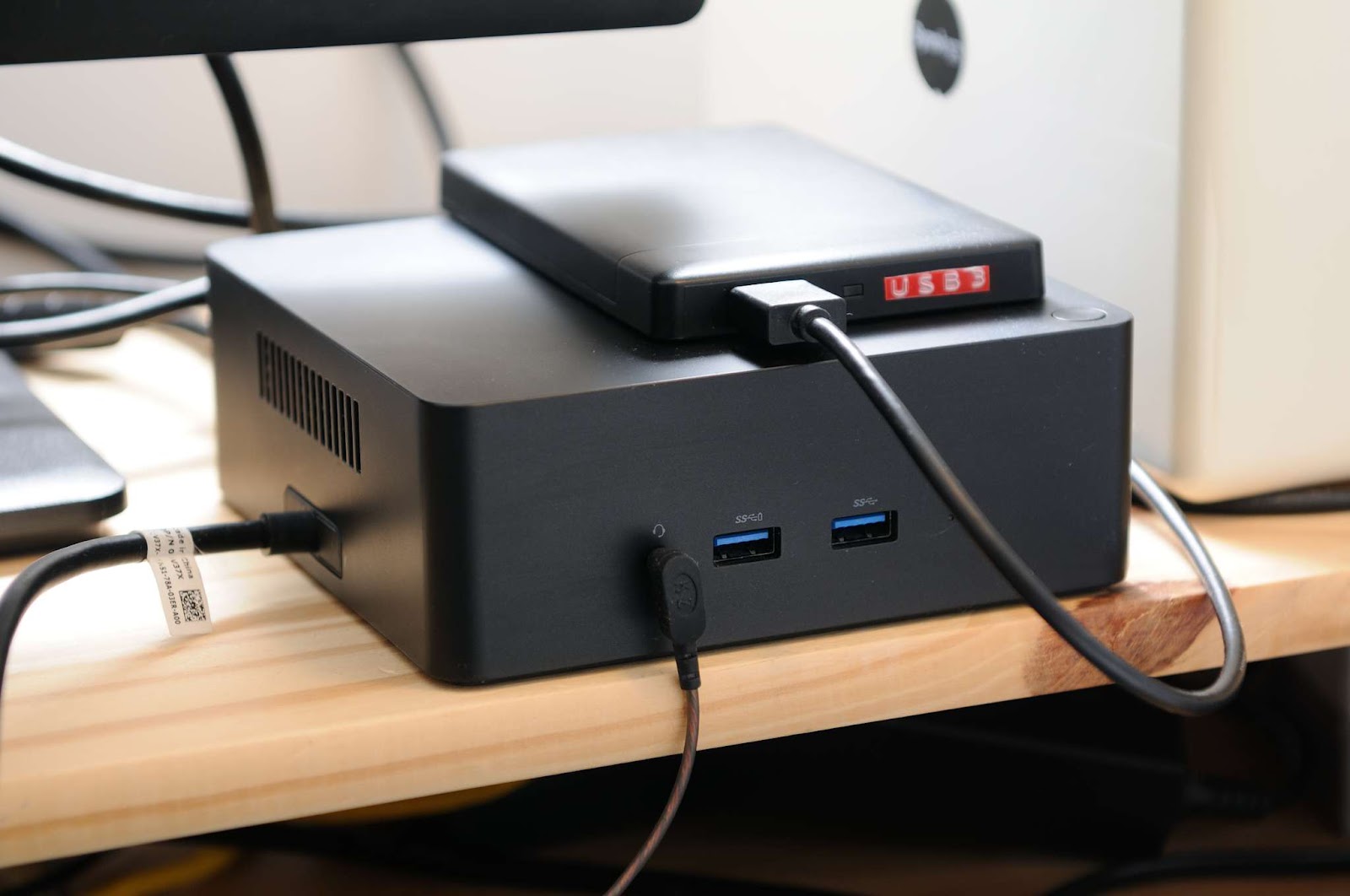
Dell TB16 docking station with Dell XPS/Fedora 35
With the Thunderbolt enabled laptop there are now more options available to integrate with your different workspaces; a docking station is one that has been a business staple for a long time but a lot of enterprise solutions are pricey but legacy and decontinued solutions exist, such as the Dell TB16 but do they perform?
Friday, 26 November 2021
Fedora 35 on a Dell XPS13 9305
The Dell XPS 93xx (2020/2021) line with its Intel Iris XE integrated graphics has a native Debian developer edition available directly and its interesting to see how this works.

Monday, 11 January 2021
Overcoming missing DisplayCAL dependacies on recent Linux distros with X11 container
DisplayCAL has been a great free tool to partner your hardware colour calibrator, like your DataColor Spyder etc. However installing this on any of the newer mid-2020 distributions (like Fedora 32 and above) has become problematic due to the

How can we continue to use your DataColor Spyder with DisplayCAL on a recent linux?
python 2 requirements being dropped by a number of distributions.How can we continue to use your DataColor Spyder with DisplayCAL on a recent linux?
Monday, 4 January 2021
Finally migrating from VMplayer to KVM
I have been running VMware, and in particular VMplayer 12.5.x, on my aging Sandybridge (circa 2010) i7-870 desktop for many years and over many interations of Fedora upgrades there have been fights to get it to continue to work.

Thursday, 31 December 2020
Fixing ffmpeg and failing hardware NVenc/dec following software upgrade
 If you find that
 ffmpeg is no longer able to use your NVidia's card for hardware decode/encode after an OS or software upgrade, ensure your running X11/NV driver and the CUDA libraries are compatible otherwise you will get cryptic error messages:
$ ffmpeg -y -hwaccel cuda -hwaccel_output_format cuda \
-c:v h264_cuvid -i 201231-163836.mkv \
-c:a copy \
-vf scale_npp=-1:720 \
-rc vbr_hq -c:v h264_nvenc \
-b:v 3M -minrate 500k -maxrate 12M \
output.mp4
...
failed call to cuInit: CUDA_ERROR_UNKNOWN: unknown error
Unable to create device
No device available for decoder: device type cuda needed for codec h264
Game Emulation Options on Linux
Emulation for old games, particularly on Linux, can be a bit of a difficult area to navigate. Whilst there are nice standalone setups like retropie, it does need a Raspberry Pi and a display. For those looking to run emulation on their normal OS will have the option of programs like Retroarch, mame and FB Neo. But where to start?

Monday, 13 July 2020
Topping E30: another DAC for linux/RPi
The Topping brand has put out various well received budget Chi-fi units over the last few years, and of interest to me, with various USB enabled DACs such as the D90, D50s and so forth. The most recent addition as of Q2 2020, the Topping E30 is a hi-res DAC with an all metal case, requiring 5v ~1A via by a 2.1mm barrel jack. The E30 has traditional inputs and outputs: toslink/coax and USB digital input and RCA out and crucially for me, without the bloat of a headphone amp or bluetooth receiver- a pure DAC.

How does it work with Linux and a RPi music server running

How does it work with Linux and a RPi music server running
forked-daapd.Sunday, 26 April 2020
Poor sound with Dell onboard Conexant CX20641 / HDA intel soundcard
Some Dell machines have a soundcard that is essentially wired up differently to how some software expects. This can be evident when using the line-out of the machine to go into speakers and finding that there is very poor bass output but can manifest itself in other soundcard jacks not behaving as expected. This is observed during enforced homeschooling on an old Dell Optiplex 390 running Fedora 32.
Verifying the soundcard is using a similar troublesome chipset:
Verifying the soundcard is using a similar troublesome chipset:
$ dmesg | grep snd_hda_codec_conexant
[ 19.026492] snd_hda_codec_conexant hdaudioC0D2: CX20641: BIOS auto-probing.
$ lspci -v -d 8086:1c20
00:1b.0 Audio device: Intel Corporation 6 Series/C200 Series Chipset Family High Definition Audio Controller (rev 04)
DeviceName: Onboard Audio
Subsystem: Dell Device 04f5
Flags: bus master, fast devsel, latency 0, IRQ 36
Memory at e4c30000 (64-bit, non-prefetchable) [size=16K]
Capabilities:
Kernel driver in use: snd_hda_intel
Kernel modules: snd_hda_intel
Saturday, 27 July 2019
New Fedora, new VMplayer startup problems
With older machines we have the risk of unsupported software hitting compatib ility problems with each OS upgrade. A recent example of this is running vmplayer 12.5.9 on Fedora 30 which ran fine on Fedo ra 26 .. 28 albiet needing a couple of tweaks
But what's the new problems on Fedora 30 and what are the workarounds?
But what's the new problems on Fedora 30 and what are the workarounds?
Wednesday, 17 July 2019
VMWare Horizon >4.8 on linux fails to start: undefined symbols
VMWare Horizon 4.8 works well with Fedora but when your service forces you to move to a later version you will find Horizon client 4.9 and above to fail to start. What to do?
Sunday, 10 March 2019
An easy way to remove duplicate files
Wednesday, 6 February 2019
Migrating an old disk to larger disk
The need for more storage is a never ending process but the processes for migrating your old disks to new has never been easier withe collective experience over the years.
But there can still be gotchas if we've been repeating our process of migrating old to new for many many years - one of these gotchas is when you are moving a disk that has its first sector startig at 63 instead of say 2048. What do we do then?

But there can still be gotchas if we've been repeating our process of migrating old to new for many many years - one of these gotchas is when you are moving a disk that has its first sector startig at 63 instead of say 2048. What do we do then?
Subscribe to:
Posts (Atom)